How to Choose a YouTube Niche You Can Test
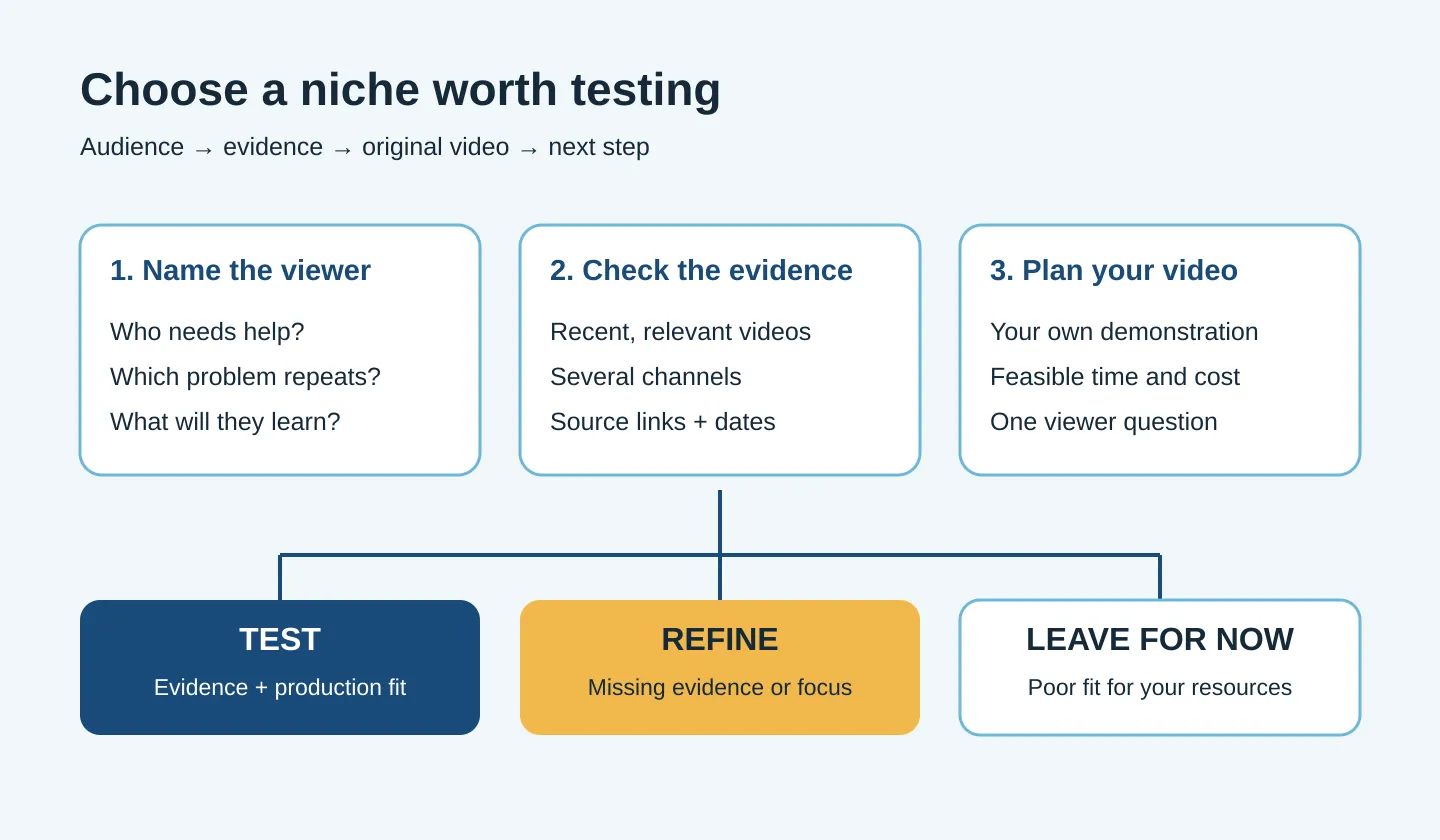
To choose a YouTube niche, name a specific viewer and problem, check whether relevant videos attract interest across several channels, and decide what useful original videos you can make. Compare two ideas using the same research method, then choose one small video test. Treat that choice as a starting hypothesis you can improve with viewer feedback.
How to choose a YouTube niche: start with a viewer
A YouTube niche is a recurring topic and audience need your channel serves. “Sewing” names a category; “simple clothing repairs for beginners with a basic sewing machine” gives you a viewer, a problem and a practical direction.
Write this sentence for each of two candidate ideas:
I help [specific viewer] do [specific job] through [videos I can make myself].
Then list three viewer questions you could answer. If each question needs a different audience or equipment you don't have, narrow the idea before researching it.
Don't choose only by personal interest, but don't ignore it either. You need both a reason for people to watch and the ability to keep making useful videos.
Check the same kinds of videos for both ideas
Use YouTube search to investigate the questions, not just the category name. For clothing repairs, try “fix loose shirt button,” “repair split trouser seam” and “shorten trousers basic sewing machine.”
For a manageable first pass, review about six relevant videos per idea across at least three channels. Those numbers are a research starting point, not a validated demand threshold. Use a similar mix of questions, formats and video ages for both ideas so one doesn't get an easier comparison.
Record:
- The exact search phrase and video URL.
- The publish date, visible view count and date you checked it.
- What the video actually answers, after watching the relevant section.
- Repeated viewer questions, including whether the video or creator already answers them.
- Whether interest appears on several channels rather than one standout upload.
A video with many views shows attention to that video. It doesn't tell you how many people searched for the topic, whether the views came from recommendations, or how a new channel would perform. An older video has also had longer to collect views than a recent one.
Keep observations separate from conclusions
An observation describes what you saw; an inference explains what you think it might mean. Copy these five fields into a note for every source:
- Source: video or channel URL, search phrase and date checked.
- Observation: publish date, visible views, topic covered and a specific viewer question.
- Possible meaning: a question worth investigating or an angle you might serve.
- Limit: what the source doesn't establish, such as current demand or an unanswered gap.
- Next check: another search, channel or demonstration that could change your conclusion.
For example, a question about repairing stretchy fabric may suggest a follow-up topic. Before calling it a gap, check whether the creator answered it elsewhere and whether other videos already cover it well.
No relevant results means the evidence is missing. Try alternative wording and related problems before treating it as evidence of low demand.
Look for a useful angle you can produce
Competition is useful because it shows how other creators serve the audience. A crowded category can still contain a specific problem you can explain well; a quiet category can lack either coverage or viewer interest.
Watch the closest answers and ask:
- What does the viewer already get from these videos?
- What would my video add: a clearer demonstration, a different constraint, a useful comparison or a test?
- Can I create that addition with my own knowledge, footage and available resources?
“Same tutorial with a different title” is a weak reason to choose an idea. “Show the repair on thin stretch fabric, with close-ups of the stitches and the failed attempt” is a concrete production plan—if your research supports that viewer need.
Compare two ideas against your real constraints
Say a new creator owns a basic sewing machine and a phone, knows common repairs, and has four hours a week. This is a fictional planning example; the observations below are assumptions to replace with actual sources.
Idea A: beginner clothing repairs
- Viewer need: fix everyday clothes with basic tools.
- Suppose research finds: repair questions recur on several relevant videos.
- What still needs checking: which repairs already have clear answers?
- Original contribution: close-up repair demonstrations on clothes the creator owns.
- Production fit: existing tools and repair skills suit a small test.
- Next decision: test one well-defined repair question after source checks.
Idea B: recreating runway outfits
- Viewer need: make a wearable version of a designer look.
- Suppose research finds: viewers ask for patterns and cheaper materials.
- What still needs checking: which designs can the creator explain and make?
- Original contribution: an original pattern and full construction process.
- Production fit: requires more materials and pattern-making practice.
- Next decision: refine to a simpler project, or leave for now.
The repair idea is the better first test for this creator because they can deliver a useful answer within their constraints. The comparison doesn't prove it has a larger market or higher revenue potential.
Use three possible decisions:
- Test: the evidence points to a specific viewer need and you can make a useful original video.
- Refine: the audience is too broad, the apparent gap needs checking, or the production plan needs simplifying.
- Leave for now: the idea doesn't fit your skills, time or budget well enough to justify the next test.
Plan one video, then review what you learn
For the repair idea, a first test might be “How to repair a split trouser seam with a basic sewing machine.” Film the damage, the preparation, the repair and the result on the creator's own garment.
Set a practical limit before starting: for example, one four-hour production session using existing supplies. Choose a publish date and a review date two weeks later. These are planning limits, not promises about when a channel should grow.
At review, ask what the video taught you:
- Could you show the repair clearly within your time limit?
- Did viewers ask a follow-up question you can answer?
- Where did viewers leave, if retention data is available?
- Did the video receive enough impressions and views to interpret the response at all?
Low impressions alone don't settle whether the niche has demand. Improve a specific weakness or test a related viewer question before making a channel-wide decision from one upload.
If ad monetization is your goal, check the route separately
As of November 2026, YouTube lists ad-revenue-sharing eligibility as 1,000 subscribers plus either 4,000 qualified public watch hours in the last 12 months or 10 million qualified Shorts views in the last 90 days. Watch hours from Shorts views in the Shorts Feed don't count toward the 4,000-hour threshold. Meeting the thresholds doesn't guarantee acceptance: YouTube reviews the channel and its compliance with its policies. See YouTube's current Partner Program requirements for the other conditions and updates.
Choose a format you can create well, rather than picking a niche solely from a claimed earnings rate. Your research decision should end with a viewer question, an original video plan and a next check—not an income forecast.
Put your two ideas side by side
YouTube Niche Finder's free two-niche comparison worksheet lets you record audience needs, demand observations, competition and your first video test in one place. It requires no email and saves entries in the browser on that device; bring your own source links and observations.